
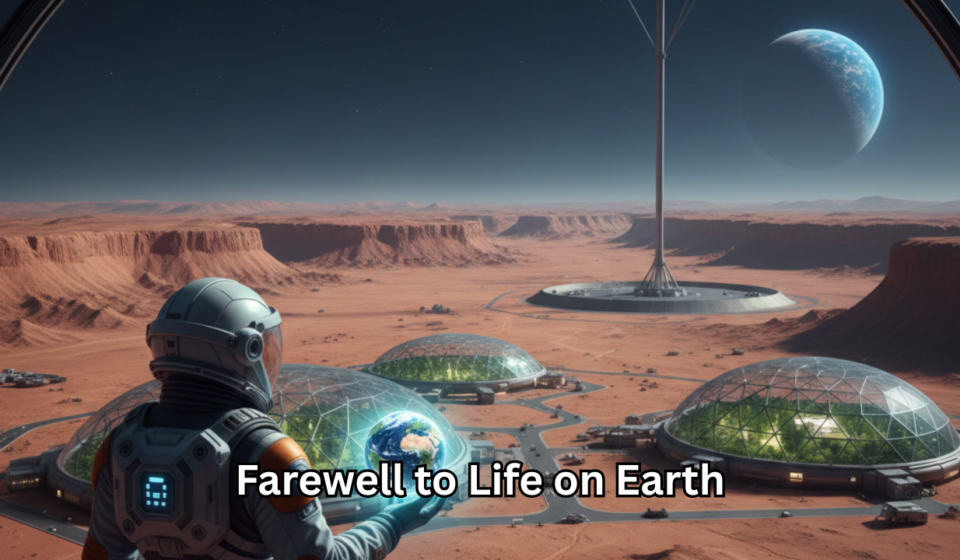

The concept of a farewell to life on Earth has long been the domain of science fiction, echoing through the halls of dystopian cinema and the pages of apocalyptic novels. However, as we stand at the precipice of a new era, one defined by unprecedented technological leaps, environmental shifts, and the burgeoning reality of multi-planetary colonization, this phrase has taken on a much deeper, more nuanced meaning. It is no longer just about the end of the world; it is about the evolution of humanity and the ultimate transition of our species from terrestrial inhabitants to cosmic wanderers.
Whether we are discussing the philosophical departure from our biological roots or the literal migration to Mars and beyond, saying goodbye to the only home we have ever known is a profound psychological and physical challenge. This article explores the various dimensions of leaving Earth, the science of survival in the void, and what it truly means to bid farewell to the cradle of humanity.
Table of Contents
The Evolutionary Necessity of Leaving the Cradle
Konstantin Tsiolkovsky, the father of astronautic theory, famously remarked that “Earth is the cradle of humanity, but one cannot live in a cradle forever.” This sentiment captures the core driver behind our urge to explore. From a biological standpoint, a single-planet species is a vulnerable species. To ensure the long-term survival of human consciousness, expanding beyond our atmospheric borders is not just an ambition, it is an insurance policy.
A farewell to life on Earth may eventually become a requirement due to the natural lifecycle of our solar system. While the sun’s expansion is billions of years away, shorter-term threats like asteroid impacts, supervolcanic eruptions, or catastrophic climate shifts remind us that our tenure here is fragile. Transitioning to a spacefaring civilization allows us to safeguard our collective knowledge, culture, and DNA against localized disasters.
Key Challenges of Terrestrial Departure
To understand the gravity of a “farewell to Earth,” we must look at the specific hurdles that make this transition so difficult. Humanity isn’t just leaving a location; we are leaving a biological support system.
- Atmospheric Pressure: Our bodies are designed for 14.7 psi of pressure. In the vacuum of space, fluids would boil and lungs would rupture without sophisticated shielding.
- Radiation Exposure: Earth’s magnetic field protects us from solar flares and cosmic rays. Beyond it, DNA damage becomes a significant risk for long-term travelers.
- Bone Density Loss: In microgravity, the human body sheds calcium at an alarming rate, requiring hours of daily exercise to prevent skeletal collapse.
- Sustainable Agriculture: We must learn to grow food in closed-loop systems without the benefit of Earth’s rich, organic soil and natural water cycle.

Comparing Earthly Life vs. Deep Space Habitation
The transition involves a radical shift in how we perceive “home.” The following comparison highlights the stark differences between our current existence and a future among the stars.
| Feature | Life on Earth (The Cradle) | Life in the Void (The Frontier) |
| Gravity | Constant 1g (Natural) | Artificial (Centrifugal) or Microgravity |
| Air Source | Photosynthesis (Biological) | Electrolysis & Scrubbers (Mechanical) |
| Water | Natural Hydrological Cycle | 100% Recycled & Reclaimed Systems |
| Protection | Magnetosphere & Atmosphere | Lead/Water Shielding & Magnetic Fields |
| Space | Infinite Horizons | Highly Confined Modules |
| Day/Night | Solar Rotation (24 Hours) | Simulated LED Cycles |
The Psychological Toll of a Planetary Farewell
How do you say goodbye to the wind, the scent of rain on dry soil, or the infinite shades of blue in a summer sky? The psychological impact of leaving Earth is perhaps the most overlooked aspect of space colonization. Humans have evolved over millions of years in perfect synchrony with Earth’s gravity, atmosphere, and circadian rhythms.
Leaving Earth means entering an environment of sensory deprivation. On a spacecraft or a lunar colony, the vibrant chaos of nature is replaced by the hum of life-support systems and the sterile gleam of recycled air. Psychologists call the shift in perspective experienced by astronauts the “Overview Effect” a cognitive shift that happens when seeing the Earth from space. While this often leads to a deeper appreciation for our planet, it also underscores the terrifying isolation of being “away.” A permanent farewell would require a fundamental restructuring of the human psyche to find comfort in the vast, silent dark.
Engineering the Great Migration: The Logistics of Departure
To facilitate a true farewell to life on Earth, we must overcome the staggering physical barriers of the “gravity well.” Escaping Earth’s pull requires immense energy, and currently, our primary method is chemical rocketry. However, to move thousands, or even millions, of people, we need more sustainable and efficient propulsion systems.
Advanced Propulsion and Space Elevators
Future migrations might rely on ion drives, nuclear thermal propulsion, or the theoretical “space elevator.” A space elevator would involve a cable anchored to the Earth, extending into geostationary orbit, allowing for the low-cost transport of materials and people. Once we are “off-planet” without the massive fuel costs of traditional launches, the true journey begins.
Habitat Construction and Terraforming
Leaving Earth doesn’t mean living in a tin can forever. The long-term goal for those saying farewell to Earth is to find or create a “New Earth.” This involves terraforming, the process of modifying a planet’s atmosphere, temperature, and ecology to make it habitable for Earth-based life. While Mars is the primary candidate, the process would take centuries, requiring us to bridge the gap with massive rotating space stations that simulate gravity through centrifugal force.
The Philosophical Shift: From Earthling to Star-Child
When we finally bid farewell to life on Earth, we also bid farewell to the identity of the “Earthling.” On a long enough timeline, humans born on Mars or in deep-space habitats will undergo physiological changes. Lower gravity would lead to longer limbs and different bone densities. Their culture would be shaped by the constraints and wonders of the vacuum, rather than the cycles of the seasons.
This philosophical shift is perhaps the most permanent part of the farewell. We would become a fragmented species, with different colonies developing unique languages, customs, and perhaps even biological traits. The “Earth” would transition from a physical home to a mythological origin point a “Mother World” that exists only in history books and digital archives.
The Ethics of Abandoning Our Home
There is a significant moral debate surrounding the idea of a farewell to life on Earth. Critics argue that focusing on leaving the planet distracts us from the urgent need to repair the damage we have done here. Should we be spending trillions of dollars on Martian colonies when the Earth’s oceans are rising and biodiversity is collapsing?
The counter-argument is that exploration and preservation are not mutually exclusive. Often, the technologies developed for space such as efficient water recycling, solar energy breakthroughs, and closed-loop agriculture are exactly what we need to save Earth. However, the ethical “farewell” must be handled with care. We cannot view Earth as a “disposable planet.” A graceful exit must involve leaving the Earth in a state where it can continue to thrive, even if we are no longer its primary residents.
Life in the Void: What We Leave Behind
What do we miss most when we leave? The “farewell” is a collection of small losses. It is the loss of the horizon, the loss of natural weather, and the loss of the interconnected web of life that we often take for granted. In a controlled habitat, every plant is there for a reason usually oxygen production or food. The “useless” beauty of a wild forest or a desert sunset becomes a luxury of the past.
Art and literature will likely become the primary vessels for Earth’s memory. Future generations will listen to recordings of birdsong and watch high-definition videos of crashing waves, trying to understand a world where life grew spontaneously and without the aid of a computer-controlled thermostat. This nostalgia will be the hallmark of the post-Earth human experience.
The Final Horizon: Beyond the Solar System
A farewell to life on Earth is only the first step. The ultimate farewell is to our solar system itself. Interstellar travel represents the greatest challenge in human history. With current technology, a trip to the nearest star, Proxima Centauri, would take tens of thousands of years.
To achieve this, we would need “generation ships” massive vessels where entire lifetimes are spent between the stars. The people who arrive at the destination would be the distant descendants of those who originally said goodbye to Earth. For them, Earth would be a legend, a speck of dust in the rear-view mirror of history. This represents the total culmination of the farewell: the point where humanity is no longer tethered to its origins in any physical sense.
Conclusion: The Bitter-Sweet Goodbye
The farewell to life on Earth is not a single event, but a long, slow transition. It is driven by our curiosity, our survival instinct, and our restless spirit. While the thought of leaving our green-and-blue marble is tinged with sadness, it is also a testament to our success as a species. We are the only known life forms capable of contemplating our own planetary exit.
As we look to the stars, we carry Earth with us in our DNA, in our memories, and in the very way we perceive the universe. We may leave the soil, but we will never truly leave the lessons the Earth taught us. The farewell is not an end, but a spectacular new beginning.
Also Read: Zach Justice Age: Everything You Need to Know About the Dropouts Star



Comments are closed.
[…] Also Read: Farewell to Life on Earth: A Journey Beyond the Pale Blue Dot […]
[…] single planet. However, modern science and global risks have introduced a profound question: could humanity one day say farewell to life on […]