

Accounting can feel like a maze when you first step into it. Numbers everywhere, debit on one side, credit on the other, and somehow they must match. That is where the trial balance example steps in like a referee in a football match, making sure both teams are playing fair.
Table of Contents
What Is a Trial Balance?
A trial balance is a statement that lists all ledger account balances at a particular date. It has two columns: one for debit balances and one for credit balances. The total of both columns should be equal. If they are equal, it suggests that the basic arithmetic of bookkeeping is correct.
Think of it like checking your shopping bill. You add up all the items and compare them with the total amount charged. If both match, you feel confident. The trial balance works the same way for accounting records.
Why Trial Balance Is Important in Accounting
The trial balance is important because it:
- Helps check the accuracy of ledger posting.
- Acts as the base for preparing financial statements.
- Makes it easier to detect errors early.
- Saves time when preparing profit and loss accounts and balance sheets.
Without a trial balance, preparing final accounts would be like building a house without measuring the bricks first.
Basic Components of a Trial Balance
A trial balance has three main parts. Simple, but powerful.
Debit Column
This column contains balances of asset and expense accounts. Examples include cash, furniture, rent expense, and salaries.
Credit Column
This column contains balances of liability, capital, and income accounts. Examples include capital, bank loan, sales, and accounts payable.
Account Titles
These are the names of ledger accounts such as Cash Account, Purchases Account, Sales Account, and Capital Account.
Types of Trial Balance
Not all trial balances are prepared at the same stage. There are three common types.
Unadjusted Trial Balance
Prepared before adjusting entries. It shows balances directly from the ledger.
Adjusted Trial Balance
Prepared after adjustments such as depreciation, outstanding expenses, and prepaid income.
Post-Closing Trial Balance
Prepared after closing entries. It contains only real and personal accounts, not nominal ones.
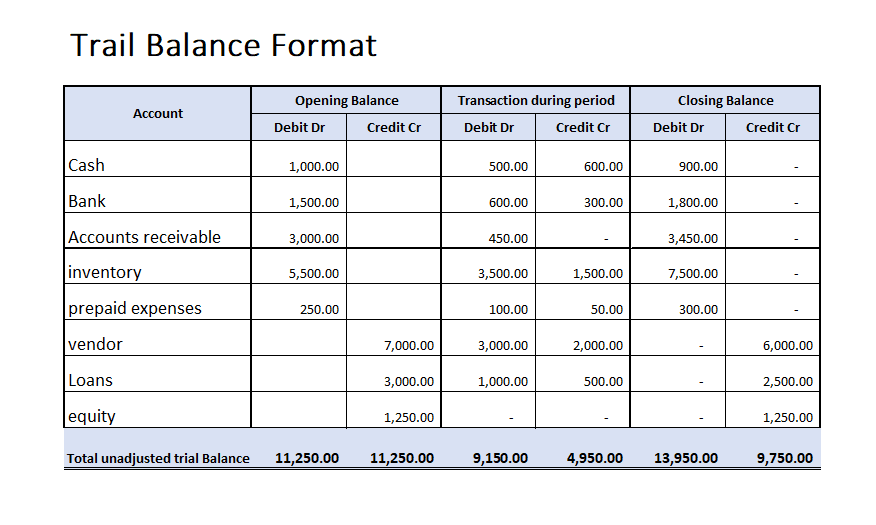
Trial Balance Format
There is no single rigid format, but two common ones are used.
Simple Trial Balance Format
Account Name | Debit | Credit
Columnar Trial Balance Format
Account Name | Debit (Rs.) | Credit (Rs.)
This format is more practical and widely used in exams and businesses.

Rules of Debit and Credit in Trial Balance
Understanding debit and credit is like learning traffic signals before driving.
Assets and Expenses
These normally show debit balances.
Examples: Cash, Furniture, Rent Expense.
Liabilities, Income, and Capital
These normally show credit balances.
Examples: Capital, Sales, Loan Payable.
Trial Balance Example (Simple Business)
Let us take a small shop example.
Example Data
At the end of March, the ledger balances are:
- Cash: 20,000 (Dr)
- Capital: 50,000 (Cr)
- Purchases: 15,000 (Dr)
- Sales: 25,000 (Cr)
- Furniture: 10,000 (Dr)
- Rent Expense: 5,000 (Dr)
Preparing the Trial Balance
We list all accounts and put their balances in the correct column.
Final Trial Balance Table
Trial Balance as on 31st March
| Account Name | Debit (Rs.) | Credit (Rs.) |
|---|---|---|
| Cash | 20,000 | / |
| Purchases | 15,000 | / |
| Furniture | 10,000 | / |
| Rent Expense | 5,000 | / |
| Capital | / | 50,000 |
| Sales | / | 25,000 |
| Total | 50,000 | 75,000 |
Here, totals are not equal. That means either data is incomplete or wrong. If capital was 70,000 instead of 50,000, totals would match. This shows how trial balance helps catch mistakes.
Trial Balance Example (Service Business)
Now consider a service business like a tuition center.
Ledger Balances
- Cash: 30,000 (Dr)
- Capital: 30,000 (Cr)
- Service Revenue: 12,000 (Cr)
- Salaries Expense: 7,000 (Dr)
- Electricity Expense: 2,000 (Dr)
- Bank: 3,000 (Dr)
Trial Balance Preparation
Trial Balance
| Account Name | Debit (Rs.) | Credit (Rs.) |
|---|---|---|
| Cash | 30,000 | / |
| Bank | 3,000 | / |
| Salaries Expense | 7,000 | / |
| Electricity Expense | 2,000 | / |
| Capital | / | 30,000 |
| Service Revenue | / | 12,000 |
| Total | 42,000 | 42,000 |
Here, both totals match. This means ledger posting is arithmetically correct.
Trial Balance Example (Trading Business)
Now let us take a trading business.
Sales and Purchases Accounts
Ledger balances:
- Opening Stock: 20,000 (Dr)
- Purchases: 40,000 (Dr)
- Sales: 60,000 (Cr)
- Cash: 15,000 (Dr)
- Creditors: 10,000 (Cr)
- Capital: 5,000 (Cr)
Trial Balance Table
Trial Balance
| Account Name | Debit (Rs.) | Credit (Rs.) |
|---|---|---|
| Opening Stock | 20,000 | / |
| Purchases | 40,000 | / |
| Cash | 15,000 | / |
| Sales | / | 60,000 |
| Creditors | / | 10,000 |
| Capital | / | 5,000 |
| Total | 75,000 | 75,000 |
Balanced trial balance means records are mathematically accurate.
Common Errors in Trial Balance
Even if totals match, errors can still exist.
Errors That Affect Trial Balance
- Wrong totaling of ledger accounts.
- Posting one side only.
- Recording wrong amount in one column.
Errors That Do Not Affect Trial Balance
- Complete omission of a transaction.
- Recording in wrong account.
- Compensating errors.
These are like two wrong turns that accidentally bring you back to the right road.
How to Correct Trial Balance Errors
When totals do not match, corrections are needed.
Suspense Account
If the difference is not immediately found, it is put into a suspense account temporarily.
Rectification Entries
Once the error is found, journal entries are passed to correct it.

Difference Between Trial Balance and Balance Sheet
People often confuse these two.
Purpose
Trial balance checks arithmetic accuracy.
Balance sheet shows financial position.
Structure
Trial balance lists all ledger balances.
Balance sheet lists only assets, liabilities, and capital.
Advantages of Trial Balance
Trial balance has several benefits.
Accuracy Check
It ensures that debit and credit totals agree.
Basis for Financial Statements
It serves as the base for preparing profit and loss account and balance sheet.
Limitations of Trial Balance
It is useful, but not perfect.
Hidden Errors
Some errors remain undetected even if totals match.
No Profit or Loss Determination
Trial balance itself does not show profit or loss. It only prepares the ground for it.
Practical Tips for Preparing Trial Balance
Use of Accounting Software
Modern software prepares trial balance instantly. Examples include QuickBooks and Xero.
Manual Preparation Tips
- Check ledger totals carefully.
- Match debit and credit entries.
- Recheck addition.
Trial Balance in Modern Accounting
Automation
Today, trial balance is generated automatically from accounting systems.
Cloud Accounting Systems
Cloud tools allow real-time trial balance access from anywhere.
Conclusion
A trial balance is like a mirror for your accounting system. It reflects whether your books are standing straight or leaning to one side. By learning how to prepare and read a trial balance, you gain confidence in your financial records. Whether you are running a small shop, a service business, or a trading company, the trial balance is your first checkpoint before moving to financial statements. Mastering it is not just an accounting skill, it is a business survival tool.
FAQs
1. What is the main purpose of a trial balance?
The main purpose is to check the arithmetic accuracy of ledger accounts and ensure debit equals credit.
2. Can a trial balance be prepared monthly?
Yes, it can be prepared monthly, quarterly, or annually depending on business needs.
3. Does a balanced trial balance mean no errors?
No, some errors may still exist even if totals match.
4. Which accounts appear in trial balance?
All ledger accounts with balances appear in trial balance.
5. Is trial balance part of final accounts?
No, it is prepared before final accounts and helps in their preparation.



Leave a Reply
You must be logged in to post a comment.
[…] Also Read: Trial Balance Example: A Complete Guide for Beginners […]
[…] Also Read: Trial Balance Example: A Complete Guide for Beginners […]